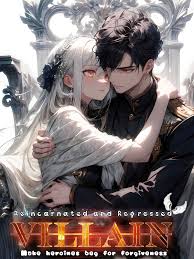
The Story in 3 Sentences
A modern man reincarnates into a fantasy world as Ryuk, the destined villain, and spends his first life as a benevolent ruler who unites the continent and eradicates evil—only to be betrayed by the very heroines he saved from suffering.
After his brutal death at their hands, he regresses back in time with full memories and a hardened resolve, rejecting forgiveness and embracing a ruthless path to dismantle the hypocrisy of protagonist halos and blind moral righteousness.
Armed with cunning, a mysterious system, and unshakable clarity, Ryuk sets out not just for revenge, but to force those who wronged him to confront their own contradictions—making them beg not for mercy, but for the forgiveness they never deserved.
Why It Stands Out
1. Villainy With Vision
Unlike typical revenge tales where the protagonist flips from weak to overpowered overnight, this novel crafts a villain whose cruelty is deliberate, strategic, and philosophically grounded. Ryuk doesn’t just punish—he exposes. His actions force readers to question the moral laziness of “heroic” archetypes who benefit from chaos yet condemn order when it lacks their approval.
2. Emotional Architecture Over Power Fantasy
While the story includes harem and action elements, its core strength lies in psychological depth. Each heroine’s betrayal stems from warped idealism, not malice, making their eventual breakdowns tragic rather than satisfying. The narrative avoids cheap catharsis by lingering on the cost of both tyranny and naivety.
3. Narrative Misdirection as a Weapon
The author openly warns readers not to trust surface impressions—a promise fulfilled through layered reveals and shifting loyalties. What begins as a straightforward villain-revenge plot evolves into a geopolitical and metaphysical struggle, where even the system Ryuk relies on may have its own agenda.
Characters That Leave a Mark
There’s Diana – the blue-haired saintess whose rigid moral absolutism blinds her to the bloodshed she indirectly enables, clinging to the belief that peace must be bloodless even when the alternative is mass slaughter.
You’ll meet Karina, who owes her family’s survival to Ryuk’s intervention against a royal execution order, yet condemns his methods as excessive, revealing how trauma can warp gratitude into resentment.
And Esme? They’re the one who pierces through Ryuk’s emotional armor not with pleas, but with quiet loyalty and perceptiveness, becoming the first to see him as more than a tyrant or a savior—just a man shaped by betrayal.
The Flaws Fans Debate
Pacing suffers in the middle arcs, especially during the island sequence, where political maneuvering and cryptic dialogues slow momentum and frustrate readers expecting consistent revenge payoff.
The MC occasionally remains inexplicably ignorant about world mechanics despite having ruled an empire for decades in his past life, creating moments of artificial vulnerability that feel contrived.
Overuse of internal monologue and excessive physical descriptions interrupt dialogue flow, with some scenes spending paragraphs detailing a character’s posture or glance instead of advancing tension or plot.
Must-Experience Arcs
Ch. 44–50: First Betrayal Arc – Ryuk confronts the initial fractures in his relationships with the heroines, particularly Diana and Karina, as their justifications for turning against him expose the fragility of their moral frameworks.
Ch. 98–104: Drishti Confrontation Arc – A high-stakes clash between Ryuk and the enigmatic Drishti unfolds, revealing deeper layers of the system’s influence and marking Ryuk’s shift from reactive vengeance to proactive world-shaping.
Ch. 350–376: Final Reckoning Arc – The narrative converges as Ryuk faces the consequences of his choices, not in a battle of swords, but in ideological duels with former allies, culminating in a resolution that prioritizes emotional truth over conventional victory.
Killer Quotes
“So, Diana, what’s your excuse for betraying me?”
“You killed them without mercy, and although you saved my family, it was not worth it.”
“Indeed, now I see. These idiots think this whole world works like they think it would.”
Cultural Impact
The line “Make heroines beg for forgiveness” became a meme template across Webnovel and Reddit communities, symbolizing anti-simp sentiment in villain-reincarnation genres.
Despite being discontinued temporarily, the novel amassed over 2.3 million views and a 4.7-star rating from readers who praised its subversion of harem tropes.
Fan discussions frequently cite it as a benchmark for “ruthless but rational” MCs, influencing reader expectations for moral complexity in similar xianxia and fantasy revenge stories.
Final Verdict
Start Here If You Want:
A villain who refuses to be redeemed by love or pity.
Heroines whose betrayals stem from ideology, not cartoonish evil.
A revenge story that evolves into a meditation on power, perception, and the cost of peace.
Study If You Love:
Narratives that deconstruct the “chosen one” myth through antagonist perspective.
Psychological realism in fantasy settings where trauma shapes ethics.
Stories that use regression not for power resets, but for philosophical recalibration.
Avoid If You Prefer:
Clear-cut morality where heroes are purely good and villains purely evil.
Fast-paced action without introspective or political detours.
Harem dynamics that end in harmonious reconciliation rather than emotional reckoning.