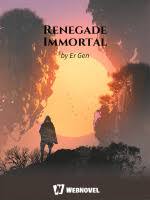
The Story in 3 Sentences
A frail village boy named Wang Lin enters the brutal world of cultivation with nothing but desperation and filial duty, only to be crushed by its cruelty and reborn through relentless will.
His journey fractures into eras of mortal sorrow, celestial betrayal, and cosmic solitude, where every gain in power is paid for in blood, loss, and the slow erosion of his humanity.
Ultimately, he transcends fate itself—not for glory, but to resurrect the one soul who saw him as human, defying heaven, time, and death to reclaim a love buried beneath millennia of cultivation.
Why It Stands Out
1. The Mortal Heart in an Immortal Shell
Renegade Immortal refuses to glorify cultivation as mere power fantasy. Instead, it roots Wang Lin’s ascent in visceral human grief—his tears over dead parents, his trembling hands after his first kill, the quiet despair of outliving everyone he loves. These mortal arcs aren’t side stories; they’re the novel’s spine, making every breakthrough feel earned through emotional sacrifice rather than plot convenience.
2. Antagonists with Cosmic Weight
Unlike many xianxia villains defined by cartoonish evil, Renegade Immortal’s foes operate on philosophical opposition. The main antagonist isn’t just powerful—he embodies a worldview that contradicts Wang Lin’s very existence, turning their final confrontation into a clash of cosmic ideologies, not just fists. This depth transforms battles into existential debates, elevating the stakes beyond survival to the meaning of cultivation itself.
3. Writing That Evolves With Its Hero
Er Gen’s prose matures alongside Wang Lin. Early chapters feel raw and functional, mirroring the protagonist’s naivety, but by the mid-novel, sentences coil with poetic dread and layered metaphor. Readers don’t just witness Wang Lin’s comprehension of the Dao—they feel the narrative itself deepen, as if the text breathes the same air as its characters, making the reading experience a parallel cultivation journey.
Characters That Leave a Mark
There’s Li Muwan – the gentle alchemist whose quiet devotion becomes Wang Lin’s only tether to his lost humanity, her death haunting him across lifetimes and driving his ultimate defiance of cosmic law.
You’ll meet Situ Nan, who – despite his flamboyant arrogance and chaotic antics, serves as both mentor and brother, sacrificing his own path to shield Wang Lin during his most vulnerable years and leaving a legacy of loyalty that echoes through the void.
And Liu Mei? They’re the one who bridges mortal ambition and celestial duty, a prodigy groomed to inherit a planet’s spiritual mantle, whose rivalry and reluctant respect for Wang Lin expose the tragic cost of destiny imposed by others.
The Flaws Fans Debate
The romance subplot feels tonally disjointed—Li Muwan’s introduction lacks emotional buildup, making her later centrality seem abrupt compared to the novel’s otherwise meticulous pacing.
Some side characters vanish without resolution, their arcs abandoned as the story scales into cosmic realms, leaving fans frustrated by unfulfilled potential.
The early chapters suffer from uneven prose, a common critique tied to Er Gen’s inexperience at the time, though most agree the writing dramatically improves past chapter 250.
Must-Experience Arcs
Ch. 1–100: The Mortal’s Descent – Wang Lin’s heartbreaking failure in the Heng Yue Sect, his return to a destroyed village, and his first steps into true cultivation through desperation and cunning.
Ch. 500–900: The Suzaku Planet Ascension – Liu Mei’s trials, Wang Lin’s manipulation of celestial politics, and his confrontation with the planet’s ancient will, where strategy outweighs brute force.
Ch. 1800–2088: The Final Defiance – Wang Lin’s war against the universe’s architects, his resurrection of Li Muwan, and his ultimate choice to abandon godhood for a quiet life beyond fate’s reach.
Killer Quotes
“If you wish to live, you must become merciless and vicious. Only then do you have the qualifications to survive!”
“Situ, you once taught me that the cultivation world is cruel and runs on the law of the jungle. If one is careless for a moment, they will perish.”
“I don’t need to cultivate to be a celestial being—I cultivate to bring back the one who made me human.”
Cultural Impact
Renegade Immortal is widely regarded as the novel that cemented Er Gen’s reputation as a master of emotional xianxia, influencing a generation of authors to prioritize character trauma over power scaling.
Its “mortal arcs” became a benchmark in the genre, with fans coining the phrase “Wang Lin tears” to describe moments where cultivation novels successfully evoke genuine sorrow.
The 2023 donghua adaptation sparked massive meme culture around Situ Nan’s chaotic energy and Wang Lin’s stone-faced reactions, with clips of “Wang Lin calculating while everyone dies” going viral on TikTok and YouTube.
Final Verdict
Start Here If You Want:
A protagonist whose ruthlessness is born from unbearable loss, not edginess.
A cultivation journey where every level-up carries emotional and moral weight.
A story that begins in mud and ends among stars, yet never forgets the heartbeat of its human core.
Study If You Love:
Narrative structures that mirror character development, where prose style evolves with the hero’s consciousness.
Xianxia that interrogates the cost of immortality rather than romanticizing it.
Mythic storytelling fused with intimate psychological realism, creating a bridge between wuxia tradition and modern existential drama.
Avoid If You Prefer:
Fast-paced action without introspective pauses or philosophical detours.
Romance that develops organically from shared scenes rather than symbolic devotion.
Stories where side characters receive consistent screen time regardless of the protagonist’s cosmic ascension.