The Story in 3 Sentences
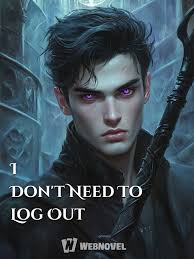
Arlon, an ordinary player in the hyper-realistic MMORPG EVR, discovers he cannot log out—and worse, realizes the game world has become his new reality, indistinguishable from actual life.
His unique knowledge of future in-game events forces him to walk the razor-thin line between player and NPC, manipulating systems while evading suspicion from both factions.
As he delves deeper into EVR’s hidden mechanics and ancient timelines, Arlon confronts existential questions about identity, autonomy, and what it truly means to be “real” in a world where the boundary between simulation and substance has vanished.
Why It Stands Out
1. A Meta Twist on the Trapped-in-a-Game Trope
Unlike standard isekai or litRPG tales where protagonists seek escape or domination, this novel flips the script by making the inability to log out not a curse but a quiet revelation—the character never needed to leave because he was never truly outside. The game isn’t a prison; it’s home, and that philosophical pivot reshapes every encounter, alliance, and battle into something introspective rather than purely action-driven.
2. Seamless Blend of Comedy and Existential Dread
The narrative masterfully oscillates between lighthearted banter—often stemming from Arlon’s dry, self-aware commentary—and moments of chilling isolation, where the weight of his dual existence presses down. This tonal balance keeps readers engaged without tipping into melodrama, offering levity when the stakes feel too heavy and gravity when the humor risks becoming flippant.
3. System Mechanics as Narrative Architecture
Rather than treating the game’s rules as mere backdrop, the story weaves EVR’s systems—quests, classes, levels, factions—into the very fabric of its plot and character development. Arlon doesn’t just exploit glitches; he interrogates the logic of the world itself, turning every dungeon crawl or guild negotiation into a subtle commentary on determinism, free will, and the illusion of choice in structured environments.
Characters That Leave a Mark
There’s Gellard – the brash Magic Swordsman from a fractured past timeline, whose arrogance masks deep insecurity about his role in a world that seems to have moved on without him; his clashes with Arlon reveal more about legacy than combat.
You’ll meet Zephyrion, who operates in the shadows as both informant and wildcard, his motives obscured by layers of loyalty and personal vendetta, yet his cryptic guidance often steers Arlon toward truths the system tries to bury.
And Cardon? They’re the one who commands the Academy with icy precision, embodying institutional authority within EVR’s hierarchy, yet their rigid adherence to order slowly cracks under the pressure of Arlon’s unpredictable presence, exposing the fragility of control in a world rewriting its own rules.
The Flaws Fans Debate
Some readers criticize the pacing in early chapters, noting that world-building occasionally stalls the momentum with dense exposition about EVR’s mechanics before the emotional core fully engages.
A recurring critique points to underdeveloped side characters outside the central trio, with many NPCs feeling like functional placeholders rather than fully realized individuals with independent arcs.
Others argue that the R18 elements, while present, are inconsistently integrated—sometimes serving thematic depth, other times appearing as gratuitous additions that disrupt the narrative’s otherwise philosophical tone.
Must-Experience Arcs
Ch. 1–25: Life As An NPC – Arlon grapples with his new reality, learning to mimic non-player behavior while secretly leveraging his foreknowledge to survive launch-day chaos and avoid detection by both players and system enforcers.
Ch. 109–120: Cardon Academy – Enrolled under false pretenses, Arlon navigates academic politics, hidden curricula, and ancient trials within the prestigious institution, uncovering secrets about EVR’s true origins and the blurred line between creator and creation.
Ch. 320–336: Asef’s Endgame – In the final confrontation across fractured timelines, Arlon faces the architect of EVR’s collapse, forcing a choice between restoring the old world or embracing a new reality where player and NPC consciousness merge into something unprecedented.
Killer Quotes
“I know everything that will happen in the game. I know the game is not just realistic; it’s real. And for some reason, I don’t need to log out!”
“Being an NPC isn’t about following scripts—it’s about finding freedom within the lines.”
“You think you’re playing the game? The game has been playing you since the first login screen.”
Cultural Impact
The novel sparked widespread discussion on Webnovel forums about the ethics of consciousness in simulated worlds, with fans drawing parallels to real-world AI and virtual reality debates.
Its tagline—“I don’t need to log out”—became a meme across social media, often repurposed to express comfort in digital spaces or resignation to online life during periods of global isolation.
Despite being a debut work, it amassed a dedicated fanbase that created detailed wikis, timeline maps, and fan theories dissecting EVR’s hidden lore, proving its resonance within the system-based fantasy community.
Final Verdict
Start Here If You Want:
A fresh take on the trapped-in-a-game genre that prioritizes philosophical inquiry over power fantasy.
Witty, self-aware narration that balances humor with haunting questions about reality and identity.
A completed story with a coherent arc—rare in webnovels—offering closure without sacrificing complexity.
Study If You Love:
Narratives that use game mechanics as metaphors for societal structures and human agency.
Protagonists who subvert the “chosen one” trope by embracing ambiguity rather than seeking dominance.
Stories where the setting itself functions as a character, evolving alongside the plot and themes.
Avoid If You Prefer:
Fast-paced action with minimal introspection or world-building exposition.
Traditional harem dynamics or romantic subplots that dominate the central narrative (the author explicitly states it’s a no-harem story).
Clear-cut distinctions between good and evil—this novel thrives in moral gray zones and systemic ambiguity.