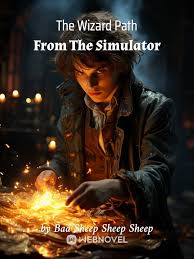
The Story in 3 Sentences
A young noble named Milton Cheney gains access to a mysterious Wizard’s Life Simulator that lets him live countless lifetimes in accelerated simulations to extract knowledge, power, or realms before returning to his real body.
This ability shifts his trajectory from a minor aristocrat in a dangerous subcontinent into a rapidly ascending wizard who defies conventional limits through ruthless pragmatism and accumulated simulated experience.
His journey expands beyond mortal planes, aiming to dominate the endless layers of the Wizard Realm by mastering both arcane techniques and existential truths gleaned from simulated deaths and rebirths.
Why It Stands Out
1. Simulation as Soul Forge
Unlike typical system novels where rewards are handed out like loot drops, this story treats each simulation as a crucible of identity—Milton doesn’t just gain spells; he absorbs lifetimes of failure, insight, and emotional residue, making his growth feel earned and psychologically layered.
2. Ruthless Worldbuilding Without Handholding
The novel drops readers into a cutthroat wizarding society where bloodlines, secret techniques, and hidden realms dictate survival. There’s no mentor holding Milton’s hand; every advantage is seized through calculation, and the world reacts with cold logic, not plot armor.
3. Structural Experimentation Within Webnovel Format
By embedding mini-stories inside simulations—each with distinct settings, conflicts, and even genres—the narrative avoids stagnation. These vignettes serve as both training grounds and philosophical playgrounds, enriching the main plot without relying on filler.
Characters That Leave a Mark
There’s Elric Voss – a disgraced archmage exiled for forbidden research, whose cryptic warnings and fragmented journals become Milton’s first real window into the deeper strata of wizardry beyond surface-level spellcasting.
You’ll meet Seraphine D’Arlon, who commands a floating observatory and trades rare astral reagents for secrets; her sharp intellect and veiled motives make every negotiation feel like a duel of wits rather than a transaction.
And Kaelen Mire? They’re the one who leads the Shadow Weavers—a guild of information brokers operating in the interstitial voids between planes—and their ambiguous alliance with Milton hinges on debts that may never be repaid in coin.
The Flaws Fans Debate
Pacing collapses after the 400-chapter mark, with repetitive internal monologues and bloated descriptions replacing the tight, simulation-driven momentum of early arcs.
The paywall hits at chapter 15, frustrating readers who need more time to assess whether the protagonist’s inconsistent naming (switching between past-life and noble identities) stabilizes.
Later chapters introduce new power systems and realms so frequently that the narrative loses focus, making Milton’s goals feel reactive rather than driven by a clear endgame.
Must-Experience Arcs
Ch. 1–45: The Subcontinent Gambit – Milton survives assassination attempts and noble intrigue by running his first life simulations, choosing between retaining realms or techniques to outmaneuver enemies far older than him.
Ch. 320–380: The Shattered Observatory – After ascending to mid-tier wizard status, Milton infiltrates a ruined celestial archive where time fractures, forcing him to run parallel simulations to recover a lost cosmology that redefines magic itself.
Ch. 1100–1180: Epochs of the Tenth Path – In the late game, Milton confronts the origin of the simulator itself during a 50-era simulation loop, wrestling with the ethics of harvesting consciousnesses to fuel his final transcendence.
Killer Quotes
“Every death in simulation is a seed. Plant enough, and your real life blooms in shadow.”
“To master magic is to unlearn certainty. The true spell begins where knowledge ends.”
“A wizard does not seek truth. He constructs it, brick by borrowed lifetime.”
Cultural Impact
Fans coined the term “Sim-Sickness” to describe the emotional whiplash of finishing a particularly tragic or profound simulation arc and returning to the main timeline.
The “Retain Realm or Retain Technique?” dilemma became a meme template across Webnovel forums, used to parody real-life choices like “sleep or finish this chapter?”
Despite early paywall complaints, the novel maintained a dedicated daily readership, with readers praising its consistent two-chapter updates and refusal to soften Milton’s morally gray decisions.
Final Verdict
Start Here If You Want:
A protagonist who weaponizes reincarnation without losing his core identity.
A magic system that evolves through philosophical trial, not just power scaling.
Narrative ambition that spans from street-level noble schemes to multiversal ontology.
Study If You Love:
Meta-commentary on cultivation tropes through the lens of simulated experience.
The psychological cost of infinite second chances in a deterministic universe.
How Eastern fantasy increasingly borrows from rogue-like game logic while retaining xianxia soul.
Avoid If You Prefer:
Fast-paced action without introspective detours into simulated lifetimes.
Consistent naming and identity for the main character across timelines.
Stories that conclude cleanly, as the novel’s 1631+ chapters lean into open-ended cosmic escalation rather than tidy resolution.